

Leading the domestic modular building sector, we boast strong comprehensive brand strength and high recognition
Our product system covers various types of buildings, flexibly adapting to diverse usage scenarios
Our products are widely used in multiple fields, with outstanding practicality and adaptability

With high recognition from global clients, we continue to expand our partnerships worldwide
2026-08-05

The factory price is only one part of the cost of importing a container house.
International buyers must also consider:
● Factory packing
● Transportation to the export port
● Ocean freight
● Origin and destination charges
● Customs clearance
● Import duty and tax
● Inland delivery
● Crane unloading
● Container return
● Foundation and installation
This is why two suppliers offering a similar house price can produce very different final project costs.
The most useful question is not simply:
How much is shipping?
A better question is:
What is the complete landed cost of this exact house configuration, delivered to this destination under a clearly defined trade term?
This guide explains the main components of container-house shipping costs and the information buyers should prepare before asking a supplier or freight forwarder for a quotation.
You can review the full HSHOUSE prefab and modular house product range before requesting transportation costs, because expandable, folding, detachable, Apple Cabin and space-capsule buildings use different packing and shipping methods. HSHOUSE currently treats these as separate product systems rather than assuming that all prefabricated houses ship in the same way.
To receive an accurate container-house shipping quotation, prepare at least:
| Destination country | Determines route, import rules and taxes |
| Destination port | Required for ocean-freight quotation |
| Final delivery city | Required for inland transport |
| Product model | Determines shipping method |
| Final packed dimensions | Determines container type and loading quantity |
| Final unit weight | Required for carrier and road planning |
| Required quantity | Determines number of containers |
| Complete configuration | Bathrooms, furniture and roofs affect volume |
| Trade term | Defines who pays which transport costs |
| Cargo-ready date | Freight rates change by sailing period |
| Site-access information | Determines truck, crane and unloading needs |
| Importer or consignee details | Required for destination clearance |
Ocean carriers generally require the origin, destination, commodity, container type, number of containers, cargo weight and cargo-ready date before providing an accurate rate quotation.
“Shipping cost” can refer to several different totals.
A supplier may quote only ocean freight, while the buyer assumes the price includes delivery to the project site.
To avoid misunderstandings, separate the quotation into three levels.
This normally refers to transportation by sea between the export port and destination port.
It may not include:
● Factory-to-port transport
● Export handling
● Destination terminal charges
● Customs clearance
● Import duty
● Inland delivery
● Crane unloading
This may include:
Destination charges may still remain the buyer’s responsibility.
This is the most useful figure for the buyer.
A practical formula is:
Landed cost = house price + packing + origin charges + ocean freight + destination charges + customs + inland delivery + unloading
The complete project budget may also require:
Foundation + installation + utility connections + approvals
These items should not be confused with ocean freight.
Ocean freight is not calculated only from the price or size of the completed house.
It depends on:
● Origin port
● Destination port
● Shipping route
● Container type
● Number of containers
● Cargo weight
● Cargo-ready date
● Seasonal demand
● Carrier availability
● Fuel-related surcharges
● Security or emergency surcharges
● Transshipment requirements
● Destination local charges
Carriers may also introduce route-specific or temporary surcharges. For example, ocean tariffs, bunker-related charges, security charges, terminal charges and local or contingency fees may all be listed separately.
Therefore, an online advertisement stating:
Shipping worldwide for $2,000
is not a reliable basis for project budgeting unless it specifies:
● Product
● Quantity
● Origin
● Destination
● Container type
● Sailing date
● Trade term
● Included charges
● Excluded charges
Container-house construction directly affects transportation efficiency.
The three most important systems are:
● Expandable container houses
● Folding container houses
● Detachable container houses
An expandable house is transported as a mostly integrated folded building.
The central structure, folding wings, wall panels, flooring, doors, windows and many internal systems remain connected.
The HSHOUSE 20ft expandable container house has approximate folded dimensions of:
5,900 × 2,200 × 2,496 mm
Its reference weight is approximately 2,800 kg, and after expansion it provides around 37.5 m² of external floor area.
● High factory-completion level
● Fewer loose structural components
● Reduced destination assembly
● Bathroom and partitions can be factory integrated
● Easier control of the finished configuration
● Each folded unit remains relatively large
● Fewer houses normally fit in one shipment
● External roofs and terraces may require separate packing
● Furniture can reduce available loading space
● Protective packaging must remain within tight dimensions
Expandable houses often provide good freight value per square metre of completed living space, even when the number of houses per container is lower.
The buyer should compare:
Freight per completed square metre
rather than only:
Number of units per container
A folding house reduces its transportation height by folding the walls between the roof and floor.
The HSHOUSE Z-Folding Container House has approximate dimensions of:
| Expanded | 5,800 × 2,480 × 2,580 mm |
| Folded | 5,800 × 2,480 × 570 mm |
| Reference weight | Approximately 1,500 kg |
The walls, floor, doors, windows and many electrical components remain integrated, reducing the number of loose parts that must be assembled at the destination.
● Much lower folded height
● Better transportation density than many expandable models
● Fewer loose components than detachable houses
● Faster unloading and deployment
● Useful for repeat camp or office projects
The final loading quantity still changes according to:
● Bathroom configuration
● Furniture
● Air conditioners
● Wall panels
● Roof accessories
● Export packing
● Total weight
● Loading method
● Unloading method
HSHOUSE does not publish one universal loading quantity for every Z-folding configuration. A model-specific packing and loading plan is required.
This is safer than assuming that every folding house can load 10 or 12 units in one 40HQ.
A detachable house is shipped as a collection of structural and enclosure components.
The HSHOUSE Top and Bottom Pre-Welded Detachable Container House keeps the main roof and base frames welded at the factory, while the columns, wall panels, doors, windows and accessories remain detachable.
This allows multiple units to be flat-packed together and can reduce ocean freight per complete house for bulk projects.
● Efficient stacking of components
● More complete house kits per container
● Lower freight allocation per unit on bulk orders
● Flexible mixed-building shipments
● Suitable for large camps and project facilities
● More destination assembly work
● Larger number of separately packed components
● Greater risk of missing or incorrectly identified parts
● More tools and skilled labor required
● More complicated packing list
● Longer unloading and inventory process
Detachable construction is often economical for large projects, but buyers must calculate both:
Shipping savings
and:
Destination labor and installation cost
A lower freight cost does not automatically mean a lower completed-building cost.
Packing may include:
● Protective film
● Corner guards
● Steel-wire bracing
● Timber supports
● Steel loading frames
● Separation blocks
● Moisture protection
● Glass protection
● Labeled accessory boxes
● Loose roof-component bundles
HSHOUSE product pages describe reinforced corner protection, anti-scratch film and steel-wire bracing as examples of international-shipping protection used for selected products.
A buyer should ask whether packing is:
● Included in the house price
● Listed as a separate charge
● Suitable for container shipping
● Suitable for flat-rack or open-top transportation
● Designed for repeated handling
● Designed for outdoor port storage
Do not assume that basic plastic film offers the same protection as a reinforced export package.
This is the cost of moving the house from the factory to the export port.
It depends on:
● Factory location
● Port location
● Container type
● Cargo dimensions
● Weight
● Truck type
● Toll charges
● Special road permits
● Empty-container pickup
● Container return arrangements
For a standard containerized shipment, an empty container may be collected, taken to the factory for loading and returned to the port.
For oversized factory-finished cabins, a flatbed, low-bed trailer or special transport arrangement may be required.
Possible origin costs include:
● Terminal handling
● Export customs declaration
● Documentation
● Container seal
● Verified gross mass services
● Port security charges
● Customs inspection
● Container positioning
● Export handling
● Bill-of-lading fees
The quotation should state whether these costs are included in:
● EXW
● FCA
● FOB
● CFR
● CIF
● DAP
● DDP
Ocean freight is normally quoted per container, not per house.
A shipment may use:
● 20GP
● 40GP
● 40HQ
● Open-top container
● Flat-rack container
● Breakbulk service
● RoRo or project cargo in special cases
A standard folding or detachable house may use conventional containers.
A large Apple Cabin or space capsule may require special equipment because the completed width, height or shape may exceed the internal dimensions of a closed dry container.
Possible carrier surcharges include:
● Fuel or bunker adjustment
● Peak-season surcharge
● Security surcharge
● Emergency surcharge
● Congestion surcharge
● Equipment imbalance charge
● War-risk surcharge
● Low-sulphur fuel charge
● Canal-related surcharge
These charges can change after an early budget estimate.
Ask for:
● Quote issue date
● Quote expiry date
● Earliest sailing
● Estimated transit time
● Surcharges included
● Surcharges excluded
Cargo insurance should be discussed separately from the house warranty.
Insurance may cover certain transport risks, while the product warranty normally relates to manufacturing or supplied components.
The quotation should identify:
● Who purchases insurance
● Insured value
● Coverage period
● Deductible
● Covered risks
● Exclusions
● Claim procedure
● Required loading evidence
Under CIF and CIP, the seller is responsible for arranging specified cargo insurance, but the required insurance levels differ.
Ocean freight arriving at the port does not mean the shipment is available without further payment.
Possible destination charges include:
● Terminal handling
● Documentation
● Delivery order
● Customs examination
● Port security
● Container scanning
● Storage
● Agency fees
● Equipment fees
● Port congestion charges
Local charges vary by country and port. Major carriers publish separate local-charge schedules by region.
The buyer should request a written estimate from a destination customs broker or freight forwarder before placing the house order.
Import costs may depend on:
● Product classification
● Declared customs value
● Country of origin
● Applicable tariff
● Trade agreements
● VAT, GST or sales tax
● Import licensing
● Anti-dumping or special duties
● Customs valuation method
The supplier can provide product descriptions, invoices, packing lists and available technical information, but the destination broker should confirm the final customs classification and tax treatment.
Do not base the import budget only on a supplier’s informal estimate unless the supplier is legally responsible for import clearance under the agreed trade term.
The customs broker may charge for:
● Entry preparation
● Document review
● Classification
● Duty calculation
● Inspection coordination
● Government-agency communication
● Bond or security arrangements
● Port release
● Delivery coordination
The buyer should appoint a broker before the shipment departs, not after it arrives.
Unexpected delay can create significant additional cost.
Demurrage generally relates to a container remaining inside the terminal beyond the allowed free time.
Detention generally relates to the container being kept outside the terminal beyond the agreed free period before empty return.
Delays may occur because:
● Customs documents are incomplete
● Import permits are missing
● Duty has not been paid
● Inland trucking is not arranged
● The site cannot receive the house
● A crane is unavailable
● The empty container cannot be returned
● Weekends or holidays reduce available time
Before shipping, confirm:
● Number of free days
● When free time begins
● Daily demurrage rate
● Daily detention rate
● Empty-container return location
● Whether extra free time can be purchased
The destination-port-to-site cost depends on:
cDistance
● Road condition
● Truck availability
● Container weight
● Bridge and road restrictions
● Urban access
● Site entrance width
● Turning radius
● Delivery appointment
● Container unloading method
A remote project may have a low ocean-freight cost but a high inland-delivery cost.
Buyers should provide:
● Exact delivery address
● GPS location when appropriate
● Road photographs
● Entrance width
● Overhead-wire information
● Bridge or weight restrictions
● Ground condition
● Available turning space
A container house does not unload itself.
Possible unloading methods include:
● Mobile crane
● Truck-mounted crane
● Forklift
● Reach stacker
● Side loader
● Container unloading platform
● Manual unloading for component kits
The correct equipment depends on:
● Unit weight
● Lifting points
● House dimensions
● Container loading sequence
● Site distance from the truck
● Ground stability
● Required lifting radius
A 6-tonne house does not necessarily require only a 6-tonne crane. Crane capacity decreases as the lifting radius increases.
The lifting contractor should review:
● Unit weight
● Lifting drawing
● Sling positions
● Required radius
● Ground conditions
● Site obstacles
When the house travels inside a carrier-owned container, the buyer may need to:
Keeping the container at the project site for several days can create detention charges.
A detachable-house shipment containing many components may require more unloading and inventory time than one integrated expandable house.
Foundation work is not normally ocean freight, but it affects the delivery schedule.
Before the house arrives, the site may need:
● Concrete pads
● Strip foundations
● Piers
● Level supports
● Drainage
● Utility entry points
● Access roads
● Crane standing area
When the foundation is not ready, the container may remain at the port, depot or site longer than planned.
Possible destination work includes:
● Unfolding or expansion
● Structural connections
● Wall-panel installation
● Roof installation
● Waterproof sealing
● Door and window adjustment
● Electrical connection
● Water connection
● Drainage
● Furniture installation
● Final inspection
HSHOUSE products vary significantly in destination labor: expandable units arrive substantially integrated, Z-folding units retain many connected components, while detachable houses require more frame and panel assembly.
The trade term can completely change what “shipping included” means.
Under an EXW-style quotation, the buyer may be responsible for collecting the goods from the factory and arranging most transportation and export steps.
This gives experienced importers greater control but may be difficult for first-time buyers.
A named-port FOB quotation generally includes the seller’s responsibility up to loading the goods on the vessel at the export port.
The buyer then arranges or pays for the main carriage and destination costs according to the contract.
Under CIF, the seller arranges and pays the ocean carriage and specified insurance to the named destination port.
However, risk transfers at the port of shipment when the goods are loaded on board—not when they arrive at the destination port.
CIF should not automatically be interpreted as:
● Duty paid
● Customs cleared
● Port charges paid
● Delivered to site
● Unloaded at site
Under DAP, the seller arranges transport to the named destination, with the goods ready for unloading.
The buyer normally handles import clearance and unloading unless otherwise agreed. Risk transfers at the named destination.
A DAP quotation must specify a precise place, such as:
DAP Project Site, Madrid, Spain, Incoterms® 2020
Writing only:
DAP Spain
is not sufficiently precise.
Under DDP, the seller takes responsibility for transportation and import formalities to the named destination.
However, a foreign seller may face legal or practical restrictions when acting as importer in certain countries.
Before accepting a DDP price, confirm in writing whether it includes:
● Import duty
● VAT or GST
● Customs broker
● Port charges
● Inspection charges
● Inland transport
● Unloading
● Crane
● Container return
● Site installation
Do not ask:
How much is shipping to Europe?
Provide:
Destination country: Poland
Preferred destination port: Gdańsk
Final delivery city: Warsaw
The port and final city serve different purposes.
Do not ask for shipping on:
One container house
Specify:
● 20ft expandable container house
● Z-folding container house
● Pre-welded detachable house
● 40ft Apple Cabin
● Commercial container café
The shipping method can change completely between models.
Provide both:
● Initial order quantity
● Expected total project quantity
For example:
First order: 2 houses
Total project: 20 houses
A trial shipment may use a different loading strategy from a full project.
Specify whether the house includes:
● Bathroom
● Kitchen
● Furniture
● Appliances
● Air conditioning
● Pitched roof
● Terrace
● Stairs
● Guardrails
● Exterior cladding
● Solar panels
● Batteries
● Water tanks
● Spare parts
These components affect weight, volume and packaging.
Request:
● Product dimensions
● Packed dimensions
● Net weight
● Gross shipping weight
● Number of packages
● Volume
● Center of gravity when relevant
● Lifting points
Do not calculate freight from the expanded house dimensions.
The freight calculation must use the transport configuration.
Ask the supplier to state:
● Houses per container
● Number of containers
● 20GP, 40GP or 40HQ
● Open-top or flat-rack requirement
● Mixed loading
● Loose accessories
● Loading sequence
● Unloading sequence
Avoid accepting:
Approximately 10 units
without a model-specific packing plan.
Freight quotations normally have limited validity.
Tell the freight provider:
A freight quotation for August may not remain valid for a shipment produced in November.
Request prices under clearly named terms, such as:
● FOB Qingdao
● CIF Gdańsk
● DAP Warsaw project site
Do not use:
Door-to-door
without identifying who handles:
● Import clearance
● Duty
● Tax
● Port charges
● Unloading
● Container return
Prepare:
● Importer legal name
● Tax or registration number
● Consignee details
● Notify-party details
● Import licence when required
● Customs broker
● Product-use description
● Destination approval requirements
Provide:
● Delivery address
● Road photos
● Site photos
● Entrance dimensions
● Turning radius
● Ground condition
● Available crane
● Available forklift
● Foundation status
● Utility status
● Local labor availability
Confirm:
● Whether cargo insurance is included
● Coverage value
● Covered route
● Deductible
● Claim deadline
● Required evidence
● Responsible party
Common shipping documents may include:
● Commercial invoice
● Packing list
● Bill of lading
● Certificate of origin when applicable
● Insurance document when applicable
● Product description
● Technical data
● Loading photographs
● Weight information
● Material or compliance documents requested for the project
The exact document list depends on the destination and product.
A useful quotation should show:
| Quotation item | Information required |
|---|---|
| Product | Exact model and configuration |
| Quantity | Units and number of containers |
| Container type | 20GP, 40GP, 40HQ or special equipment |
| Packed dimensions | Per unit and total |
| Gross weight | Per unit and total |
| Origin | Factory and export port |
| Destination | Port and final delivery point |
| Trade term | With named place |
| Ocean freight | Clearly separated |
| Origin charges | Included or excluded |
| Destination charges | Included or excluded |
| Duty and tax | Included, excluded or buyer-confirmed |
| Insurance | Coverage and value |
| Transit time | Estimate, not guarantee |
| Free time | Demurrage and detention conditions |
| Quote validity | Expiry date |
| Unloading | Included or buyer-arranged |
| Container return | Responsibility and depot |
| Exclusions | Written clearly |
An FOB quotation will usually appear lower than a DAP quotation because it covers fewer logistics stages.
Bathrooms, furniture, roofs and solar equipment may significantly change the final gross weight.
A low ocean-freight price can be followed by high terminal, customs and local-service fees.
This can cause clearance delays and demurrage.
The truck and container may arrive before the crane or foundation is ready.
DDP normally places the goods at the buyer’s disposal at the destination, but unloading may still be the buyer’s obligation depending on the agreed contract and carriage arrangement.
A cheaper product may use container space inefficiently or require greater destination labor.
The buyer may have only limited free time after collecting the loaded container.
Assume a buyer needs accommodation for a worker-camp project.
Advantages:
● Larger interior per unit
● More factory completion
● Less site assembly
Possible higher costs:
● Fewer houses per container
● More crane planning
● Larger folded units
Advantages:
● Compact folded height
● Rapid deployment
● Fewer loose components
Possible higher costs:
● Model-specific stacking and packaging
● Simpler room layouts
● Bathroom and furniture may reduce quantity
Advantages:
● Strong bulk-loading efficiency
● Flexible camp combinations
● Lower freight allocation per kit
Possible higher costs:
● Larger installation team
● More component handling
● Longer unloading and assembly
● Greater inventory-management requirement
The correct decision depends on:
Total completed-project cost—not ocean freight alone.
Use:
Shipping allocation per house = total shipment logistics cost ÷ number of complete houses
For example:
| Total logistics cost | Houses shipped | Allocation per house |
|---|---|---|
| $6,000 | 1 | $6,000 |
| $6,000 | 2 | $3,000 |
| $6,000 | 4 | $1,500 |
| $6,000 | 10 | $600 |
However, this calculation is incomplete unless all units provide comparable floor area and configuration.
A better calculation is:
Logistics cost per usable square metre = total shipment logistics cost ÷ total finished floor area
This can make an expandable house more competitive even when fewer units fit in one container.
Send:
You can request a model-specific shipping quotation from HSHOUSE. The current contact page asks buyers to provide their destination, product type, size and quantity, and states that suitable configurations and customized design support can be prepared after complete requirements are received.
There is no fixed global shipping price.
The cost depends on the product’s packed dimensions and weight, number of units, container type, origin port, destination port, cargo-ready date, trade term and destination charges.
Not unless the quotation clearly states a delivered trade term and names the exact destination.
A factory starting price normally should not be assumed to include freight, customs, duty, tax, crane unloading or installation.
No.
CIF generally covers the goods, ocean carriage and specified insurance to the named destination port. It does not automatically include import clearance, duty, destination charges or delivery to the project site. Risk normally transfers at the shipment port when the cargo is loaded on board.
DAP can cover transportation to a named destination, including the buyer’s premises, but the buyer normally handles import clearance and unloading unless the agreement says otherwise.
Detachable houses often have strong bulk-shipping efficiency.
Folding houses can provide a balance between compact transport and rapid setup.
Expandable houses may provide lower shipping cost per square metre of finished living space.
The answer depends on project quantity and destination labor.
They can increase:
● Weight
● Packing volume
● Loading complexity
● Protective packaging
● Number of loose packages
They may also reduce the number of complete houses loaded in one container.
This depends on the trade term and freight contract.
The quotation should specifically identify who pays terminal handling, delivery-order charges, customs fees, storage and inland transport.
The shipment may incur port storage, demurrage or detention charges after the available free time expires.
HSHOUSE product and contact pages describe support for export packing, loading planning and international project communication. The final scope should be listed in the quotation and sales contract for the selected product.
A reliable container-house shipping quotation cannot be prepared from only a country name and a product photograph.
Buyers should confirm:
Exact product + complete configuration + quantity + packed dimensions + weight + destination + trade term + cargo-ready date + unloading plan
before comparing shipping prices.
The most important number is not the cheapest ocean-freight rate.
It is:
The total landed cost of a usable, correctly configured house at the project site.
Before paying a deposit, request:
● Approved configuration
● Final packed dimensions
● Gross weight
● Packing list
● Loading plan
● Container type
● Trade term
● Included charges
● Excluded charges
● Quote validity
● Destination responsibilities
This preparation reduces unexpected port fees, customs delays, incorrect crane bookings and disputes over what the original shipping quotation actually included.
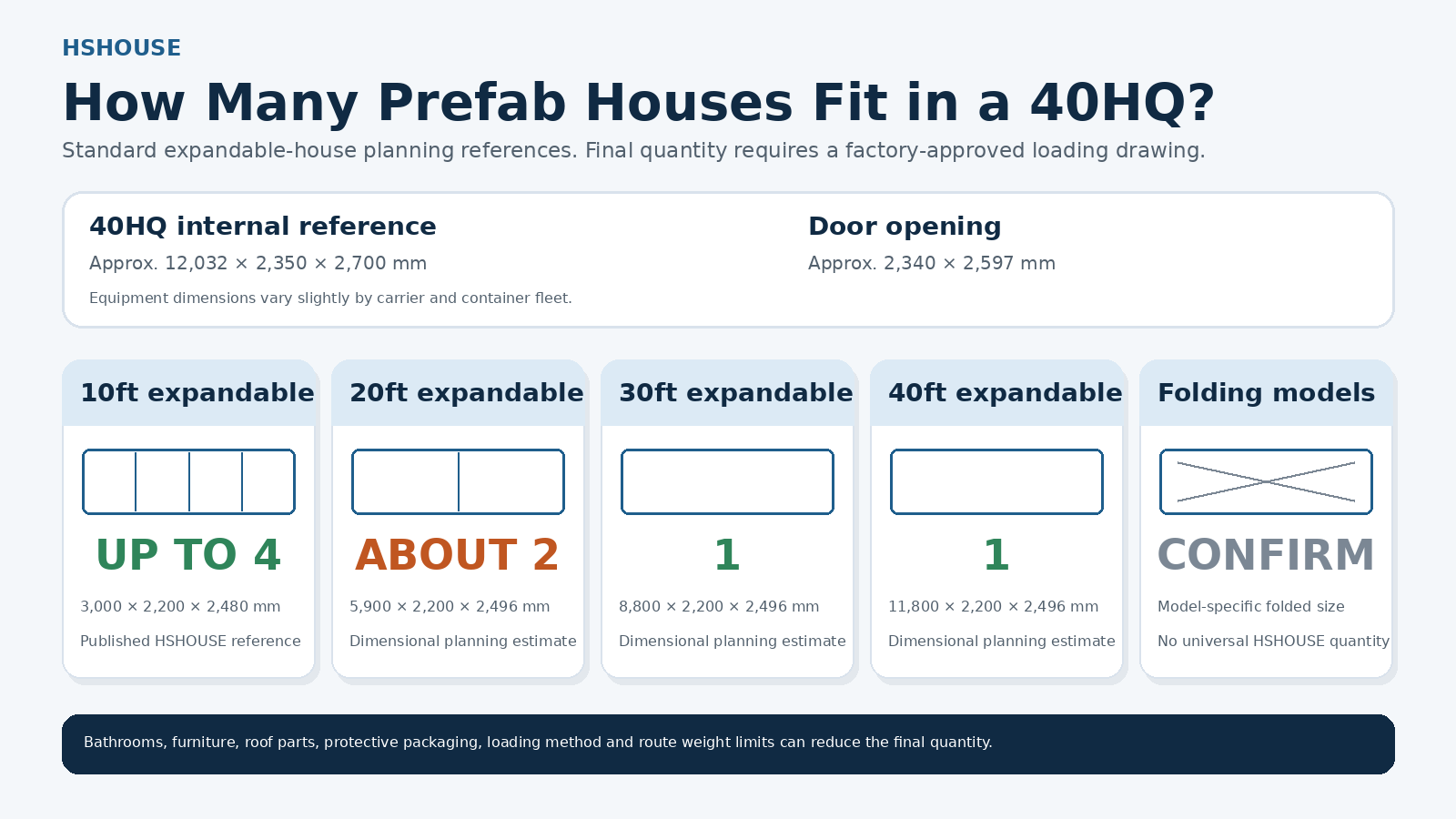
A standard 40HQ may carry up to four 10ft expandable houses, approximately two 20ft units, one 30ft unit or one 40ft unit. Final quantity depends on packed dimensions, optional equipment, packaging and the approved loading plan.
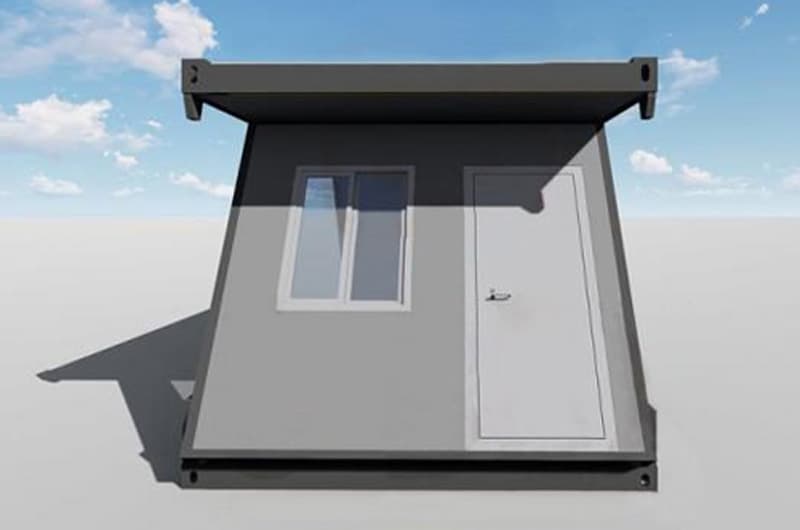
Project planning guide covering selection, limitations, cost factors, logistics, approvals and information required for a verified quotation.

Project planning guide covering selection, limitations, cost factors, logistics, approvals and information required for a verified quotation.
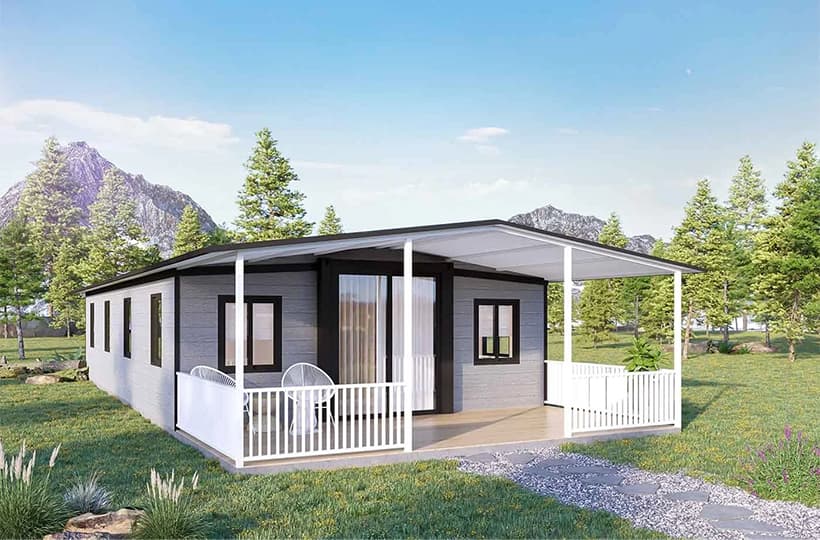
A larger nominal footprint can offer more layout choices, yet transport form, structural zones, deployment clearance and service routes still limit the plan. Send the.
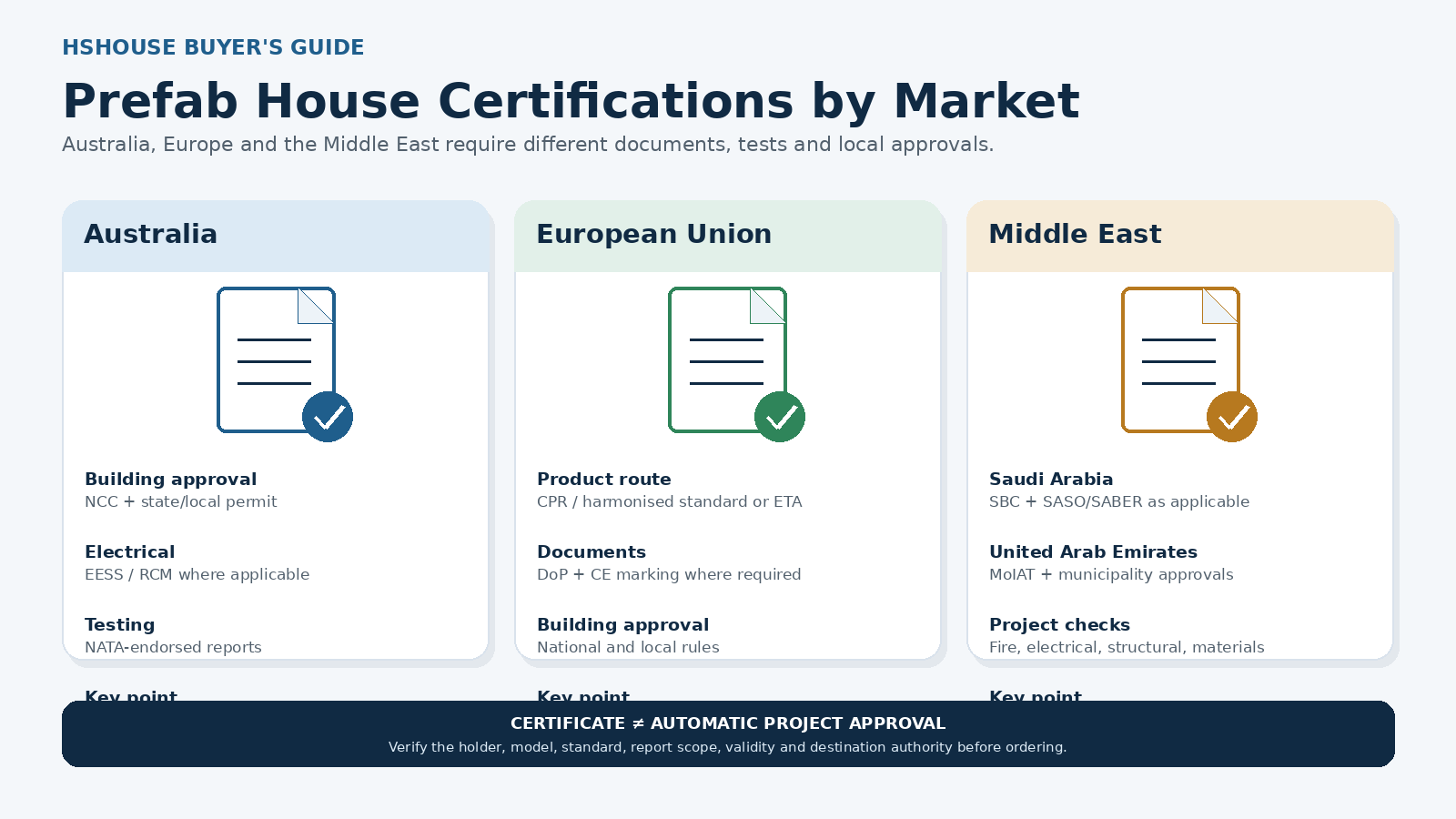
Learn which certificates, test reports and local approvals prefab-house buyers may need in Australia, Europe, Saudi Arabia and the UAE.
 +86 17563695938
 contact@hshouse.com
 No. 1099, Gongye 1st Street, Weicheng District, Weifang City, Shandong Province, China



View on Mobile
Copyright © 2026 Huisheng International Trade All rights reserved
Send us your requirements. Free custom floor plan or 3D design in 3 working days
Submit form